 EN
EN



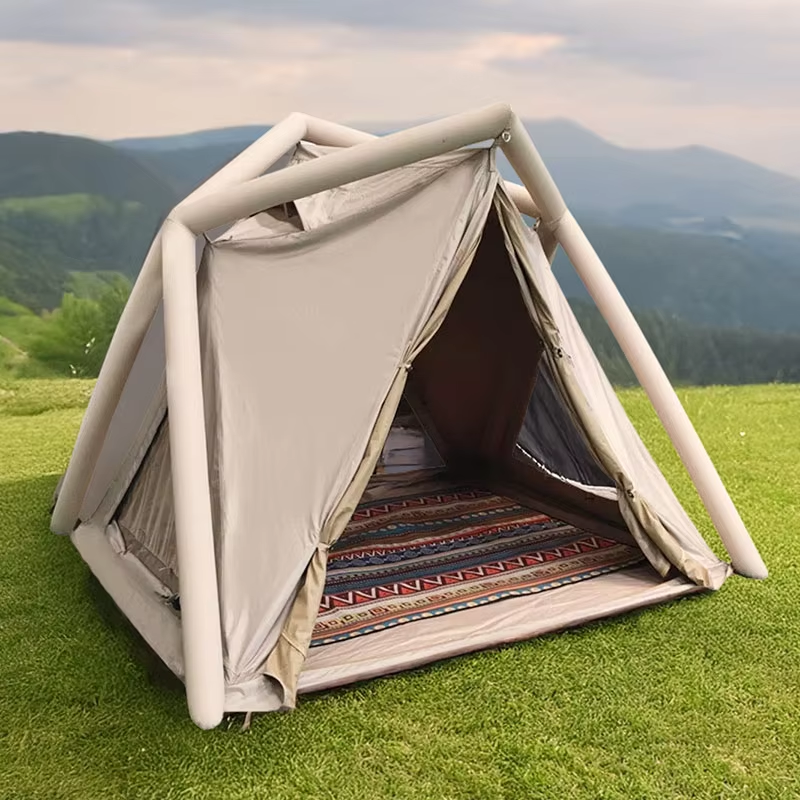
Navigating the Global Inflatable Tent Market
With the growth of popularity of the air beam technology there has been excessive crowding in the market. In case of B2B procurement managers in UK, USA, Australia, and Russia, no longer it is an issue of finding a supplier, but sieving out the manufacturer of the poor quality disposable tents. A failed business day is a failed tent in a commercial environment.
You need to see beyond the marketing photos in order to safeguard your investment and reputation of your brand. This guide provides the technical standards and red flags that business customers should consider prior to signing a large-volume purchase contract. We think that at MBNM Outdoor we have a transparent buyer as our most successful partner.
1. The Material Litmus Test: TPU vs. PVC
The most prevalent cost-saving action in the sector is done inside the air beams, where the purchaser would not look.
PVC Red Flag Many of the budget suppliers use PVC as the internal bladders. PVC is not light, smells of chemicals, and above all, has low thermal memory. It cracks when it gets cold such as Canada and Russia and stretches to death when it gets hot such as Australia and Spain.
TPU Gold Standard An absolute insistence on Polyethylene TPU. It weighs 30 percent less than PVC and is eco-friendly and does not lose its elasticity over a broad temperature span. 0.3mm 0.5mm TPU is employed by MBNM to provide the ideal balance of weight and structural rigidity, but the beams will come back to the original shape at the end of each use.
2. Seam Integrity: Welded vs. Taped
But a waterproof cloth cannot do any good when the seams break. Looking closely at the points where the fabric and air structure meet, B2B buyers should examine the points when inspecting a sample.
Heat-Welding Technology High quality inflatable tents are welded with high frequency (HF) on the air beams and at the junction between the floor and walls. This is done by means of electromagnetic energy which causes the materials to be fused into one piece. When you notice glue traces, loose threads, it is an indication of a low quality and handmade manufacturing, which will soon peel or break down under high temperature.
Stress Points Checking Reinforced Stress points Check the corners and the point where the air beams meet the canopy. Tents with professional level have these points reinforced twice. In MBNM, the secondary layer of 600D Oxford cloth is added to the other two layers to spread the tension and avoid point-load tearing in case of high winds or heavy rain.
3. The Valve and Pressure Management System
At the centre of an inflatable tent is the valve. The most common reason of slow leakages that irritate end-users and augment rental firm maintenance expenses is a cheap valve.
Inflation and Deflation Efficiency Search high flow Boston valves or high pressure special valves. These are supposed to have a one-way diaphragm that does not allow the escape of air whenever the pump is switched off. The threading must be accurate and robust in order to avoid cross threading across several setups.
Over-Pressure Protection A safety relief valve is an essential item that no tent can do without being sold in areas where the solar gain is high. When a supplier is unable to provide a pressure-release mechanism, the tent becomes an asset during the summer seasons when the air in the beams expands quickly. This is a safety measure that helps to avoid the bursting of the beams during the peak midday sun.
4. Floor Durability and Bathtub Design
The enemy when camping professionally is the ground. Ingress of water normally occurs at the bottom rather than at the top.
Material Density The tent of high quality has to have 500D to 1000D PVC or heavy polyethylene floor. It has to be much heavier and rubbery in comparison to the wall fabric. This thickness is necessary in order to resist puncture damage by rocks, twigs, or heavy camp furniture.
The Bathtub Height make sure the flooring material covers a minimum of 10-15cm on the wall before the seam sets in. This design of a bathtub is such that the interior will be dry even when the water is standing or in flash floods. MBNM floors are completely incorporated and welded to the structure to avoid the seepage nature in lower-end zip-in floor models.
5. Documentation and After-Sales Support
In the case of B2B, the relationship commences once the payment is done. The buyers who are professionals must make sure that the supplier is also capable of sustaining long term.
Certification Transparency Does the manufacturer issue legitimate ISO, CE and Fire Retardancy (CPAI-84) certificates? To meet international requirements needed in the UK, EU, and North America, professional purchasers must demand original PDF reports.
Spare Parts and Repairability A professional supplier needs to provide modular repair kits and replacement bladders of TPU. Provided the air beam is installed in the tent in a manner that cannot be pulled off, the whole tent becomes garbage in case of a hole. MBNM provides air beam designs that have easy zipper sleeve designs enabling easy maintenance and replacement of parts at the site.
Conclusion: Choosing a Partner, Not Just a Vendor
Inflation change to inflatable camping equipment is an enormous growth prospect in the outdoor industry. The low cost trap has however destroyed many retail brands. It can guarantee you that your stock will turn into a long-term investment and not a short-term nightmare because of the quality of TPU, the accuracy of HF welding, and safety standards.
At MBNM Outdoor, we have our rice behind each stitch and each beam. We welcome the B2B buyers and ask them to dispute our specification and understand why we are the reliable manufacturing partner of the most demanding brands in the outdoor world.